
A wedding programme tells your guests what happens, in what order, and who is who. It can be a printed card on every chair, one board at the door, or a section on your wedding website. You'll also see it spelled "wedding program". It's the same thing. In South Africa we write "programme".
Do you need one? No. A ceremony runs without it. But your guests will ask what time to arrive, how long the ceremony is, and when supper starts. A programme answers all of that once.
This guide gives you the order of the day, the order of the ceremony, what to write, wording to copy in English and Afrikaans, and an example.
The order of a South African wedding day
Here is one way a South African wedding day can run. It is an example only: every venue and every couple has their own timeline and their own order of events. Copy this table, then change it to suit your venue, your marriage officer, and your photographer. Every length is a guide, never a rule.
| Part of the day | What happens | Typical length (a guide) |
|---|---|---|
| Guests arrive | Music plays and guests find their seats | About 30 minutes before the ceremony |
| The ceremony | The entrance, the vows, the rings, the signing | About 15 to 20 minutes without a religious service. About an hour with one |
| Photos and canapés | Family photos first, then drinks and canapés for your guests while you take your couple photos | 90 minutes to 2 hours. Family photos take 30 minutes at most |
| Guests are seated | Guests are called to dinner and find their tables | About 10 minutes |
| Your entrance | The two of you walk in | About 10 minutes |
| Dinner | The meal is served | About an hour |
| Speeches and toasts | All the speeches together | About 30 minutes in total |
| First dance | The dance floor opens | About 5 minutes |
| The cake | You cut the cake | About 10 minutes |
| The send-off | The last song, then your guests see you off | About 5 minutes each |
Some couples move the speeches to before dinner, or between courses. Some skip the cake. The order is yours. What matters is that your guests can see it.
The order of the ceremony
People often ask for the five parts of a wedding ceremony. Whatever the tradition, most ceremonies come down to these:
- The entrance. The wedding party walks in, then the bride, or the two of you together.
- The welcome. The marriage officer greets everyone and says why you're all here.
- The vows and the rings. The promises, then the rings.
- The signing. You sign the register with your witnesses.
- The walk out. You leave first, married, and everyone follows.
A church service and a civil ceremony both hold those five. They fill in the rest differently. The two orders below are examples only: every venue, every church, every marriage officer and every couple has their own ceremony and their own order of events.
| A church service | A civil ceremony |
|---|---|
| 1. The entrance | 1. The entrance |
| 2. The welcome, often with a hymn | 2. The welcome |
| 3. The declarations and the vows | 3. The legal declaration and the vows |
| 4. The rings and a blessing | 4. A reading, if you'd like one |
| 5. A Bible reading and a short talk | 5. The rings |
| 6. Signing the register | 6. You're declared married, and the first kiss |
| 7. Prayers and a final blessing | 7. Signing the register |
| 8. The walk out | 8. The walk out |
Every church has its own order, and every marriage officer has their own way. Ask yours for the order before you write a word. Then put that order in your programme, in plain words. A civil ceremony can be very short: 10 to 15 minutes is common. A religious service can run an hour or more.
The signing takes a few minutes. Plan a song for it, and name it in your programme so your guests know to stay seated.
What to put on your wedding programme
Keep it short. A guest should take it in at a glance.
- Your names, the date, and the place. The top of the page.
- The order. The ceremony, or the whole day, in the order it happens. Add times if you know them.
- The wedding party. Your marriage officer, your parents, your bridesmaids and groomsmen, and anyone doing a reading.
- The music and readings. The song titles and who reads what, if you'd like to credit them.
- A thank you. One or two lines to your families and your guests.
- A note on photos. If you'd like phones away during the ceremony, say so here. It's called an unplugged ceremony.
- Someone you're remembering. A line for a loved one who can't be there, if that feels right.
What to leave off: long stories, every lyric, and anything your guests don't need in the moment. If it reads like a booklet, cut it in half. Your story belongs on your wedding website, where there's room for it.
We design the Wedding Day Programme for R697, if you'd like yours made for you. You get a print-ready file, so you can print it as cards or as one board.
Wording to copy
Three lines in English, and three in Afrikaans. Change the names and make them yours.
English
- The welcome: "Welcome to our wedding. We're so glad you're here."
- Phones away: "Please keep your phones in your pockets during the ceremony. Our photographer will share every photo with you."
- The thank you: "Thank you for your love, for the long road you travelled, and for the years of friendship that brought us here."
Afrikaans
- Die verwelkoming: "Welkom by ons troue. Ons is so bly julle is hier."
- Fone weg: "Sit asseblief julle fone weg tydens die seremonie. Ons fotograaf deel al die foto's met julle."
- Die dankie: "Dankie vir julle liefde, vir die ver pad wat julle gery het, en vir die jare se vriendskap wat ons tot hier gebring het."
For the invitation itself, our guide to digital wedding invitations in South Africa covers formats and wording.
Printed, on a board, or on your website
Printed. A card or a folded page on every chair. It's lovely to hold and to keep. It needs a final guest count, a printer, and time, and any change after printing means printing again.
On a board. One large programme at the entrance. Everyone sees it on the way in, and there's only one to print. Guests can't take it to their seats, so keep the order short enough to remember.
On your wedding website. The order of the day sits behind the same link as your venue map and your RSVP. Your guests see it weeks before the wedding, on their phones. If a time changes, it's changed once, for everyone.
You can do more than one. Many couples put the full day on the website and keep the printed card for the ceremony.
The website version does one more job. It answers "what time must we be there?" before anyone sends the message. On a WedlySite website, the Order of Events section is R247, added to The Whole Story at R2,997. Here is what to include on a wedding website, section by section.
An example: Jake & Bella's order of the day
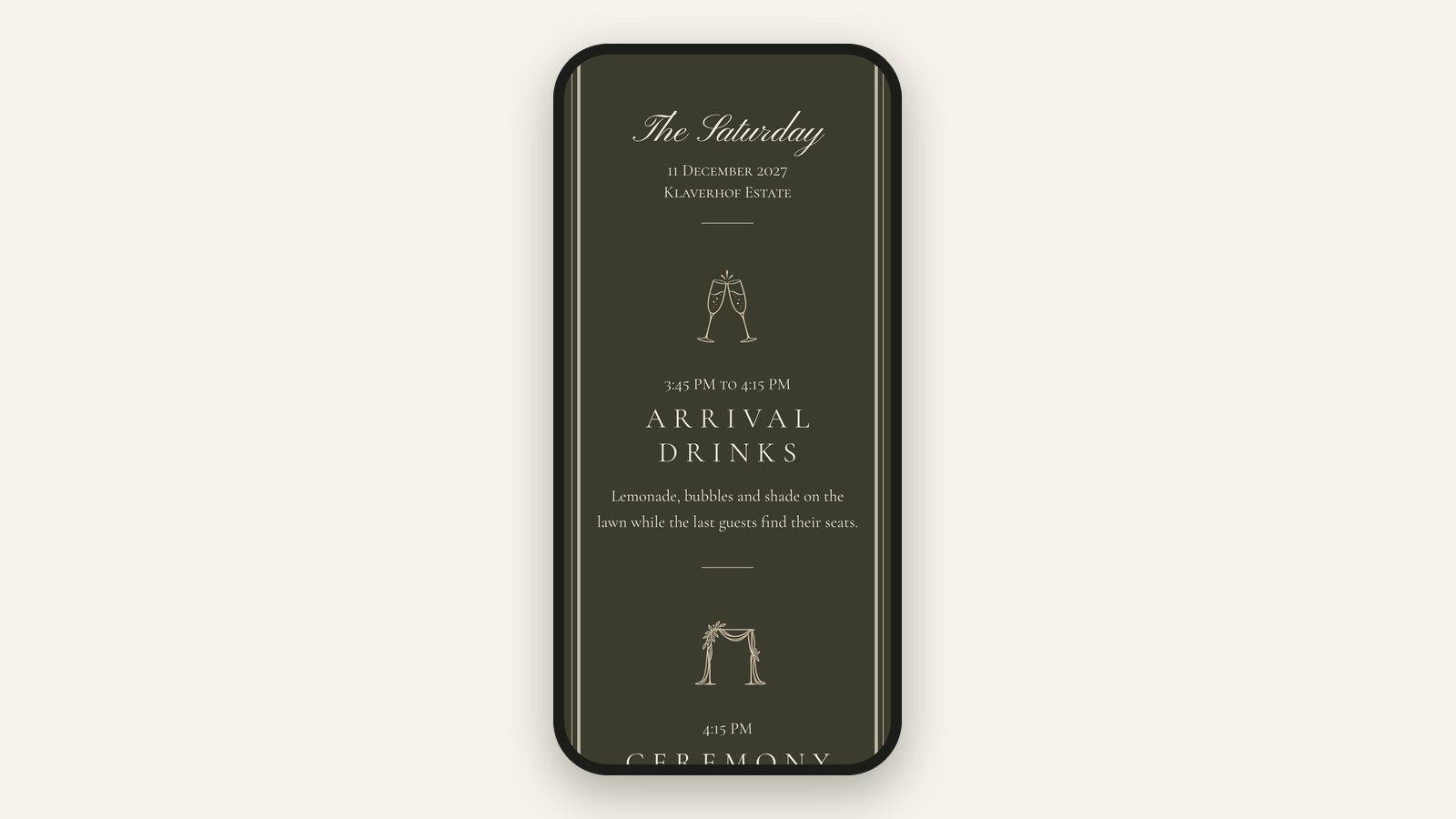
This comes from one of our example websites. Jake & Bella are a demo couple who marry in Paarl, and their website has a section called Schedule. It covers the whole weekend. This is their Saturday, word for word:
The Saturday
11 December 2027
Klaverhof Estate
3:45 PM to 4:15 PM. Arrival Drinks
Lemonade, bubbles and shade on the lawn while the last guests find their seats.
4:15 PM. Ceremony
Twenty minutes, two promises and one very nervous groom.
4:45 PM to 6:15 PM. Sundowners & Canapés
Small bites on the terrace as the mountains turn pink, and photos for anyone who asks nicely.
6:45 PM until late. Dinner and Dancing
A long table in the old barn, toasts from the people who know us best, then a band that plays until the candles burn down.
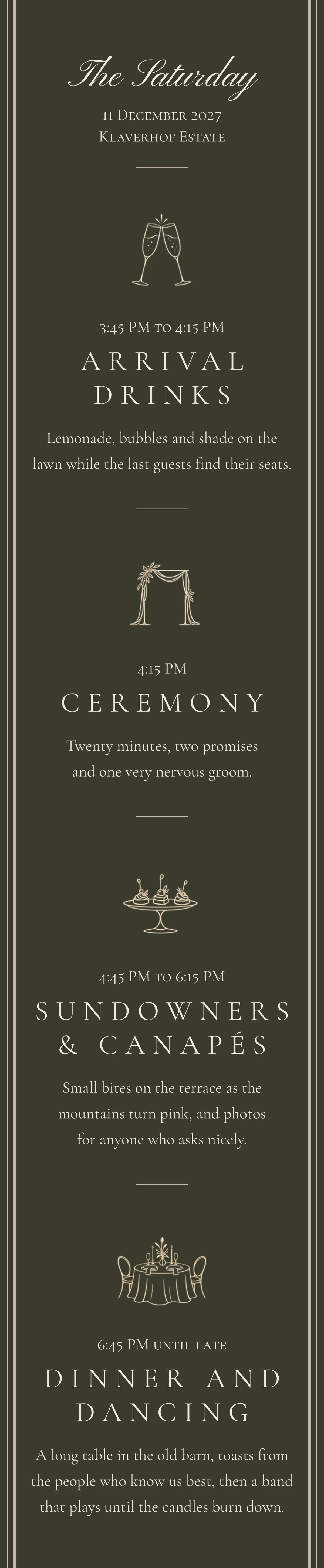
Four lines, and a guest knows the whole day. Each one has a time, a name, and a sentence that sounds like the couple. Their Thursday and Friday sit above it, with a vineyard tour and welcome drinks for the guests who arrive early.
Open Jake & Bella's website and tap Schedule in the menu to see it on your phone.
Before you finalise yours
- Ask your marriage officer for the order of the ceremony.
- Ask your venue and your photographer for their timings.
- Check every name's spelling with the person it belongs to.
- Send your guests the times early. Our wedding invitation timeline shows when each piece goes out.
WedlySite builds custom wedding websites and digital invitations for South African couples. You talk. We write, design, and build. You share one link. Closer to the wedding, The Big Day Set brings the Wedding Day Programme, the seating chart, and the two RSVP reminders together for R1,797. See our pricing, or read our guide to creating a wedding website in South Africa first.
Quick answers
What are the 5 parts of the wedding ceremony in order?
The entrance, the welcome, the vows and the rings, the signing of the register, and the walk out. A church service adds hymns, a Bible reading, a short talk, and a blessing. A civil ceremony may add a reading. Ask your marriage officer for their exact order.
Do I need a programme for my wedding ceremony?
No. A ceremony runs without one. A programme helps your guests follow the order, know who is who, and know what happens next. It can be a printed card, one board at the entrance, or the order of events on your wedding website.
How do I draft a wedding programme?
Start with your names, the date, and the place. Ask your marriage officer for the order of the ceremony and list it in plain words. Add the wedding party, a short thank you, and a note on photos if you'd like phones away. Keep it to one page.
Is it "wedding programme" or "wedding program"?
Both mean the same thing. "Programme" is the South African and British spelling. "Program" is the American spelling.
How long does a wedding ceremony take?
As a guide, about 15 to 20 minutes without a religious service, and about an hour with one. A civil ceremony can be as short as 10 to 15 minutes. Your marriage officer can tell you how long yours will run.